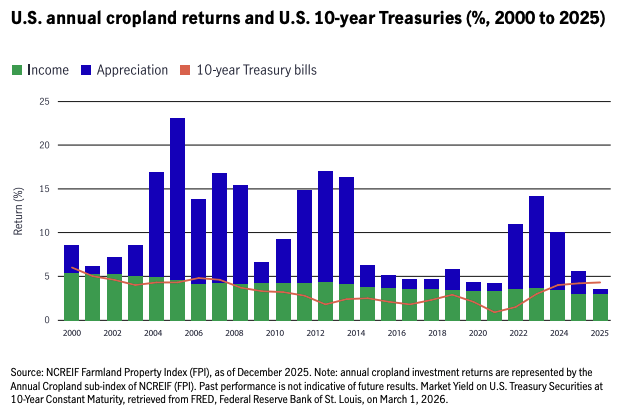
Manulife Investment Management explains why farmland can serve as a long-term real asset by combining income, capital appreciation, inflation sensitivity, and diversification. The paper argues that demand fundamentals remain favorable as global grain and oilseed consumption has grown 2% annually since 2005, while U.S. farmland has delivered equity-like returns with considerably lower volatility.
Why Invest in Farmland?
Manulife
Research
20 Pages
Key Takeaways
Competitive returns: U.S. farmland returned 9.6% nominal and 7.1% real annually from 2006–2025, comparable to equities with lower volatility.
Superior risk-adjusted: U.S. farmland produced a 1.20 Sharpe ratio versus 0.51 for the S&P 500 over 2006–2025.
Demand supports value: Grain and oilseed consumption grew 2% annually from 2005–2025, with China, the U.S., India, and the EU accounting for over 50% of demand.