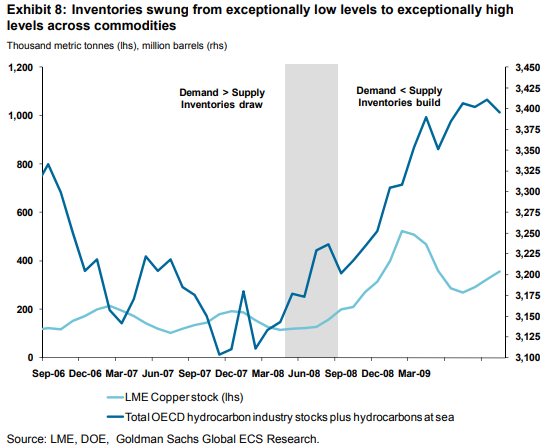
Goldman Sachs explains how commodity prices and volatility are driven less by speculation than by physical supply constraints, inventories, and marginal production costs. It argues infrastructure bottlenecks amplify price swings, while long term investment uncertainty, rather than financial flows, has been the dominant force behind commodity market behavior.
Commodity Prices and Volatility: Old Answers to New Questions
Goldman Sachs
Jeffrey Currie, Allison Nathan
Research
44 Pages
Key Takeaways
Physical Constraints Matter: Physical infrastructure limits, not investors, primarily drove volatility, with speculators adding only about $9.50/bbl to the 2008 oil price run up.
Marginal Costs Dominate: Oil shifted from an exploitation phase to an investment phase, pushing marginal costs above $100/bbl in 2008 and supporting much higher long dated prices.
Inventory Drives Volatility: Goldman estimates rising prices forced roughly 5 million b/d of developed market oil demand out over the previous decade as inventories and supply constraints tightened.